
Natural Religion
Quick announcement:
On July 1st, I’ll randomly select one of my paid subscribers, who’ll receive a gilded Stoic ornament as a gift. See the details by clicking here.
On a cold and wet day in April, we drove into an industrial park on the edges of a suburban town. My nerves knotted my stomach as we pulled up to a building that looked more like a warehouse than a clinic.
Beyond the nondescript entrance was a pale green reception room lined with shelves of soft toys in pink or blue and framed portraits of smiling couples. We confirmed our appointment to a neatly dressed receptionist and sat by a shelf of gender-reveal confetti cannons.
My wife’s name was called. We went into the clinic. Three kind women were waiting for us in the darkened room lit silver by just two screens.
The seated technician, as kind and serene as you’d hope any nurse would be, explained everything to us as she searched methodically through the inner space of my wife’s womb.
She paused. “Do you see that flicker?”
My second child. 14.7mm from head to rump, curled up in the only universe it will know for nine months.
I’ve sought masterpieces in obscure churches, I’ve wandered the Vatican Museum at sunset, I’ve seen prehistoric finger paintings lit by torchlight in the belly of a mountain, but no masterpiece could touch me so deeply as the image on this wavering grey-scale screen — a child floating in the amniotic sac like the rabbit in the moon with a beating heart no bigger than a poppy seed.
My throat thickens. A wave washes over me — the power and the glory of life. I’m here, sitting in a chair beside my wife on a spinning sphere that’s hurtling through space at sixty-seven thousand miles per hour, watching two hearts beat in one body.
Life is profoundly mysterious. In rare moments we’re shaken out of the slumber of habit and struck by how stupid and blind we are in the face of its mysteries.
I’m a lapsed catholic, I walk into churches only to admire the worldly works of architects and artists, but I’ve always carried a sense of the divine.
Natural Religion and the Tiered Fountain
My feeling for the divine is intuitive, and remains so — every time it erupts into something substantive it withers under the vigilant scrutiny of my logical scepticism. I hold not so much a faith or belief, as an operative assumption that the divine exists. Existence itself is the original miracle.
This is all akin to the project of natural religion, which gives a name to many people’s attitude to the existence of the divine. Natural religion — often also called natural theology — is the investigation of the divine through the faculties that are natural to human beings.
The idea is that the human mind, left to its own devices and with nothing more than sense, introspection, and logic, might arrive at God or something like God. This is to be contrasted with “revealed religion”, which is based in scripture and testimony of supernatural events.
Natural religion is considered to be the means by which people arrive at a basic notion of the divine even without any knowledge of scriptural texts or testimony.
The idea of divine existence is argued by advocates of natural religion to be a bedrock of belief, one that makes us more predisposed to revelation.
Imagine for a moment a world where religion never appeared, no churches, temples, or mosques, no sacred texts, no spiritual traditions. In such a world it is still likely that people would find the divine, and they’d do so by reasoning.
Natural religion is the reason why so many intelligent people believe in often preposterous ideas and superstitions. It’s also the reason why so many more describe themselves as “spiritual but not religious”.
They have a notion of the divine that is thought out, but not much else for their heart to clasp out for. Like the tendril of a vine, their heart reaches blindly, but it nevertheless reaches out as it cannot help but do so.
I use the word divine, and will do so from now on, because the word “God” implies and connotes too much. We think of gods as agentic — “personal” gods commanding, law giving, punishing, even beseeching.
As a category, the divine encompasses God — and gods — but is best defined as that which is antecedent to nature or being as we know it. The divine can be impersonal, non-agentic or even non-active.
The enterprise of religion is built up from a pre-cognitive understanding of the world. The religion you inherit from your culture, or that you more deliberately embrace through conversion, is built upon a foundation that is less a belief than a fundamental and entirely personal intuition that’s fostered in the situatedness of our engagement with each other and the world. Things seemingly, at the least, exist for the whole.
People have a will to believe in something beyond nature because the alternative is too far fetched for them: laws without a law-giver, movement without a first-mover, order from nothing, and, of course, something instead of nothing.
The amateur sceptic will look at the revealed religions and see an attempt to understand the world, gasping in the airlessness of uncertainty. They see simplistic and primitive ways to explain the workings of the world — the creator gods, the legislator gods, the regent gods.
But this misses the most important aspect of religion, which is not even the will to belief, but the intuition that supports belief.
And this amateur sceptic is like the congenitally deaf man watching people dance for the first time in his life — he doesn’t understand why they would be acting as they are.
For better or worse, organised religions build on this predisposition to intuit the divine, this flicker of belief. They channel it into belief, ritual, and worldview.
Most atheists take issue with the “baggage” that comes with religion — moral prescriptions, ritual, mythologies, and the encroachment of all of these aspects of religion on society. In religion, faith functions as an organising principle.
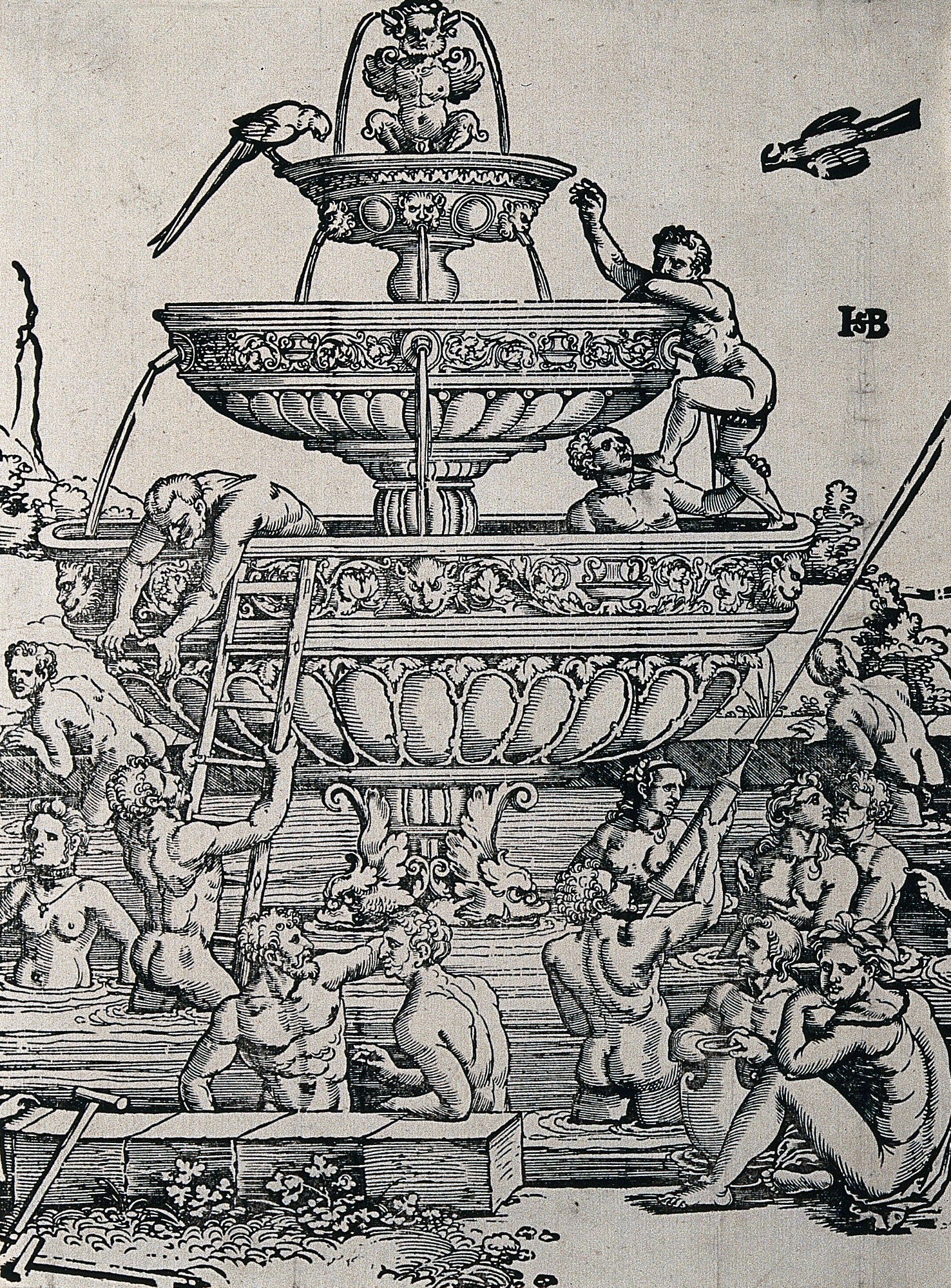
But consider for a moment religion as a tiered fountain. Beliefs, rituals, prescriptions for social order, such as the sacraments of Christianity, and so on are the lower tiers of belief through which the sacred cascades. The fountainhead — the origin of the sense of the sacred — is the understanding of the divine.
As the water cascades from tier to tier it can become more sullied, but there where it emerges it is always pristine. It is here, the unsullied spring of reason, not belief, that gives life to all that follows.
The Three Classical Arguments
Natural religion rests on a huge diversity of arguments. But here are three of the most popular and fundamental arguments for divine existence.
The ontological argument is the argument of the existence of God from the idea of God — that God must exist because God, by definition, is maximally great.
There are a number of ontological arguments, but to take one and simplify it, it would be as follows: a perfect being must necessarily exist, since existence is better than non-existence. God is a perfect being, therefore God exists.
The argument was first formalised by Anselm of Canterbury, and went through several iterations from later philosophers.
It has been strongly refuted, most notably by Immanuel Kant, who pointed out that existence isn’t a predicate. In other words, existence isn’t a property like roundness or firmness.
You can use Anselm’s logic to prove the existence of a perfect anything — a perfect island, or a perfect cup of tea, which doesn’t mean that perfect specimen exists. You cannot derive existence from a concept.
Despite this, the ontological argument has persisted through iterations and refinements. Most recently, there are “modal” versions that argue for the existence of the divine through possibility rather than necessity. The argument is debated to this day.
The cosmological argument is the argument that for things to exist, there must necessarily be a primary cause of their existence. The uncaused cause is the divine. The most famous example of the cosmological argument is Aristotle’s “unmoved mover” as the uncaused cause of all motion in the Cosmos.
A nuanced example of this argument that also straddles an ontological argument is Ibn Sina’s “proof of the truthful”.
According to the Persian polymath, everything is contingent on other things, that is, they require something else to exist. You need your mother to exist, and carbon atoms, and the sun, and so on. But the aggregate of contingent things cannot be self-explanatory — there must be a “necessary existent”, and there is only one possible necessary existent.
The teleological argument holds that the order and apparent purpose (or purposiveness) in nature can only be explained by an intelligent designer, rather than by blind chance. The universe seems ordered and all things within it interrelate with a high degree of purpose — the coordinated structure of living organisms is taken for evidence of divine origin.
Thinkers as diverse as Thomas Aquinas and Epictetus endorsed this idea, and it persists as the “intelligent design” argument. But it’s perhaps the weakest of the three arguments here — apparent design doesn’t necessarily point to a designer, and the natural process of evolution shows that complexity can emerge from chance.
But again, the overall argument persists and remains compelling in the light of arguments for cosmic “fine-tuning” because they are largely expounded on the terms of science.
But if the divine exists, what is its form and purpose?
As I mentioned, in most people’s minds a personal creator god is at the apex of divinity. This is a god that makes decisions, that sometimes intercedes in earthly life, and a personal yet omniscient god that can be related to.
It’s also a god that sees into your private life and perhaps even knows your thoughts. Many of us pray in private, assuming the omniscience of God (or gods).
But there’s many ideas about god and the divine. The impersonal God of Deism doesn’t bother humanity. The pantheistic god is identical with nature, a pure immanence in everything — even excrement. The gods of the Epicurean materialist universe exist physically — composed of atoms just like us. Perhaps like comic book superheroes Epicurean gods have superpowers, but do not concern themselves with earthly life.
The supreme “Good” of Platonism, from which all existence emanates, is a oneness that is beyond comprehension and description. Plato’s idea is similar in scope to the Brahman of Vedantic Hindu philosophy — the “that” from which all existence proceeds.
Then there’s the idealist notion that all is mind — that mind, not matter, is the substrate of all things and so there is one ultimate mind.
We have very different ideas of the divine here. The most minimal is the notion that the Cosmos is more than merely a sum of its parts.
I am open-minded about the form and purpose of the divine. I do not rule out any of the ideas above. My intuition of the divine is non-committal purely because it’s intuited.
Massimo Pigliucci, invoking British philosopher Anthony Flew, rightly insists that the burden of proof of some positive notion of god or divinity should be on the believer, and not those who refute belief.
Taking the example of a unicorn — which no adult seriously believes in — he writes, “if you claim that there are unicorns, my request for evidence is rational, while your stance that one should believe in them until someone proves that they don’t exist is irrational.”
I agree with this basic idea — that the burden of proof ought to sit with those who make specific claims about supernatural phenomena. But my rational and positive case for divine existence isn’t a belief in a particular idea of the divine but rather my opposition to naturalism.
Naturalism and the Naturalist-Materialist Paradigm
All arguments for divine existence run contrary to naturalism. In the philosophical sense of the term, naturalism is the view that nature is all there is, that everything is explainable through natural causes and processes without any appeal to anything supernatural or transcendent.
By “natural” here, we mean entities that exist in space and time and are subject to causation. Immaterial things, such as ideas, are considered by naturalism to be the consequence of physical processes.
Naturalism and materialism overlap significantly. Materialism is the specific claim that all reality is fundamentally material or reducible to matter.
Naturalist Materialism is the dominant intellectual paradigm of our age. This is largely down to the success of the sciences in explaining phenomena and the usefulness of the resulting technologies. Over the course of time naturalism has taken the mantle of seeming to be the most intuitive and reasonable world-view, pervading our collective understanding of the workings of the world.
But the naturalist-materialist paradigm has always buckled under the strain of paradoxes.
Consider this infinite mise-en-abyme: the world is external to the mind, so therefore the world is only an image in the mind, we’re therefore locked up in our heads, which only exist within themselves.
The mind-body problem is a problem inherent to naturalism. If ideas and experiences are exclusively the product of electrochemical processes, then our experience of ourselves, our existence, is a hallucination in the brain, the world “outside” is unknowable, existing to mind only as a brain-concocted correlation within the human skull.
We also have what’s now commonly called “the hard problem of consciousness” — how can subjective sensations like the taste of grapes and the smell of flowers possibly emerge from the physical matter of your brain.
The brain has been mapped very effectively — we see which parts of the brain fire up when we taste grapes or smell flowers, but nobody understands how these processes give rise to qualia — the felt qualities of experience, such as the redness of red, the sweetness of grapes. We observe a correlation between brain states and thoughts, but have no understanding of cause.
Then there are natural laws — the idea that the observed and dependable consistencies that underlie our existence, as well as everything else, are the result of impersonal laws.
The recourse to such laws is no more far fetched than the recourse to God as a law-giver, if not more far-fetched. If nature is all there is, what explains natural laws? Laws cannot merely be observed regularities. Laws must maintain consistency in all possible cases, not just all observed cases, and that necessity needs some grounding outside of nature itself, since nature itself is what is subject to those laws. To claim that the laws are observed consistencies is to relocate the mystery of consistency.
These objections are not based on “gaps” in current scientific understanding, so you cannot make the accusation that I’ve fallen into the “God of the gaps” fallacy — take note that I’ve not included “what existed before the big bang?” here. They are inconsistencies at the very foundation of a world-view, which would need to break before they are resolved.
The Original Miracle
I see no irony or contradiction that I watched my child’s beating heart thanks to the ingenuity of scientific discovery yet was washed over with the feeling of the divine. Existence is a miracle and the more we understand its particular workings, the more we can marvel at that miracle.
The three classical arguments for the existence of the divine — the ontological, cosmological, and teleological — each have weaknesses, but they converge in a direction toward a necessary ground for being, a ground that underlies the natural order rather than belonging to it.
Even if we exist in what some philosophers call a “hyperchaos” — a cosmos without any natural laws or order — there still remains being itself as an absolute, a bedrock that cannot be otherwise.
Naturalism fails on its own terms; it cannot account for conscious experience, it cannot account for the laws that provide the regularities that form its own basis, it fails to adequately bridge the representations of mind with the reality outside.
What remains isn’t proven divinity but a reasonable conclusion that nature is not self-explanatory and being itself is a miracle in naturalist terms.
I remain a sceptic in the best possible sense of that word — not to scoff or to be reflexively dismissive, but to keep a disciplined open-mindedness — about what lies at the heart of existence. But I also must acknowledge that even scepticism needs some ground. Doubt presupposes some kind of certainty, it happens where particularities of my existence intersect with universal reason. There’s no reason without necessity.
The eruption of awe in the darkened room was later a reminder to me to remain humble. Dismissal of the divine is naive. The operative assumption of divine existence isn’t a dogmatism, but rationality orienting itself toward the divine in the absence of any self-explanatory alternative. The flickering heart I saw on that screen was a reasonable occasion for reverence.
Wish your child to be born strong in body,soul and mind.Wish both you and your wife happy parenting. One deserves the future he shapes.
Wow , I really found this very inspiring , and could relate very well from a Buddhist perspective .
Daphne would have related too 🙏🏻